
Why Organizations Choose Mobile.
(And Why They Don’t Need To.)Part 5 of our Traditional Auction series | Published on AuctionZoom.com
How to read this: You’ll see tags for [Experience] (what we’ve observed consistently) and [Inference] (conclusions drawn from those patterns).
After exploring the psychology, costs, timing, and operations of charity auctions, one question remains: If traditional formats deliver superior results at lower cost, why do so many organizations choose mobile bidding? The answer reveals how an entire industry is built on solving problems that didn’t require their solution, while creating new problems that organizations didn’t anticipate.
Understanding this psychology is crucial because it explains why smart, well-intentioned fundraising professionals make decisions that ultimately cost their organizations money while weakening donor relationships. The mobile bidding industry succeeded not through superior technology, but through superior marketing that reframed operational challenges as format limitations rather than solvable implementation problems.
This piece in our series reveals the assumptions driving mobile adoption and provides the definitive comparison that settles the debate. More importantly, it demonstrates how modern auction management eliminates the false choice between operational efficiency and strategic effectiveness that mobile platforms created to position themselves as superior.
For readers just discovering this series, we recommend starting with The Gold Standard for Charity Auctions for the complete strategic framework, then returning here after exploring the psychology, timing, costs, and operations that inform this analysis.
Key Takeaways
- Organizations choose mobile based on incomplete information: Vendors reframed genuine operational problems as format limitations rather than solvable implementation challenges.
- Mobile’s value misaligns with auction economics: Premium costs concentrate on declining silent auctions (20-30% of revenue) while compromising paddle raises and live auctions (70-80% of revenue).
- Five core assumptions driving mobile adoption are false: Traditional events don’t cost more, aren’t operationally complex, aren’t outdated, reach audiences effectively, and deliver superior results with modern tools.
- Format choice reveals fundraising strategy:Events prioritizing relationship building consistently outperform those optimizing for operational convenience, with benefits compounding across donor development.
- Controlled comparisons consistently favor traditional: Side-by-side testing shows traditional delivers superior results across all metrics while building transferable fundraising capacity.
The Psychology Behind Mobile Adoption
Why Smart People Make Suboptimal Choices
Organizations choose mobile bidding for entirely rational reasons based on incomplete information about their options. The decision typically follows a predictable pattern: frustration with traditional auction operations leads to exploration of alternatives, mobile vendors highlight genuine pain points while positioning themselves as the only solution, and busy nonprofit leaders choose what appears to be the path of least resistance. [Experience]
The mobile industry succeeded by identifying real problems with old-fashioned traditional auction management: long checkout lines, manual data entry, registration bottlenecks, paper-based tracking systems, and volunteer coordination challenges, long checkout lines, payment complications, etc. These weren’t imaginary concerns—they represented genuine operational barriers that made traditional events difficult to execute well. [Experience]
However, mobile vendors then made a strategic leap that fundamentally altered the charity auction landscape. Instead of solving these operational problems while preserving the strategic advantages of traditional formats, they convinced organizations that the format itself was the problem. This reframing created a false choice: accept operational complexity or abandon traditional approaches entirely. [Inference]
Strategic Insight: The mobile industry’s marketing premise lies in conflating operational methodology with strategic approach. They convinced organizations that eliminating checkout lines required eliminating public bidding, that streamlining data entry required privatizing competition, and that modernizing meant abandoning the relationship-building dynamics that make events strategically valuable for donor development.
The Five Core Assumptions Driving Mobile Adoption
Assumption 1: Traditional Events Are Operationally Too Complex
Organizations believe traditional auctions require extensive volunteer coordination, specialized expertise, and manual processes that consume disproportionate staff time. This assumption stems from experience with outdated auction management approaches that predated modern platforms like Bidstation. [Experience]
Mobile vendors reinforced this perception by demonstrating their platforms alongside traditional approaches using paper-based systems, clipboards, and manual checkout processes. The comparison appeared obvious: sophisticated technology versus antiquated methods. [Experience]
Assumption 2: Mobile’s Higher Cost Delivers Superior Value
Organizations accept that mobile platforms cost more, typically $3,000 to $5,500 annually compared to $400-$530 for Bidstation, because they assume this premium pricing reflects superior value delivery. The assumption follows logical business reasoning: premium solutions cost more because they deliver proportionally greater results. If mobile bidding significantly increases revenue, streamlines operations, or enhances donor engagement, the higher investment would make strategic sense. [Inference]
This assumption would hold true if mobile platforms delivered proportionate to the higher costs. However, analysis reveals a fundamental misalignment: mobile’s value proposition concentrates on silent auction management, typically only 20-30% of total event revenue and the declining segment of auction fundraising events. Meanwhile, mobile technology provides minimal enhancement to live auctions, actively compromises paddle raise effectiveness through competing notifications, and eliminates the relationship-building dynamics that create long-term donor value. [Experience]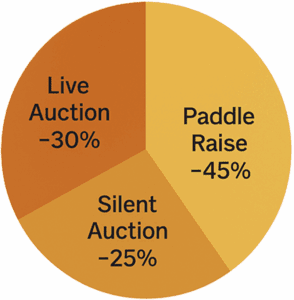
The value equation becomes clear when examined holistically. Mobile platforms charging $5,000 to optimize $15,000 in silent auction revenue (a 33% overhead rate on one segment) deliver questionable returns compared to traditional platforms charging $500 to enhance $50,000 across silent auctions, live auctions, paddle raises, and donor cultivation (a 1% overhead rate supporting your entire fundraising event). Modern traditional approaches don’t just cost 70-85% less, they deliver superior value precisely where revenue concentration is shifting: protected paddle raise focus, enhanced live auction energy, and preserved social dynamics that build lasting donor relationships. [Inference]
Organizations discover too late that they weren’t choosing between affordable and premium solutions. They were choosing between technology that solves the wrong problems expensively and operations that solve the right problems affordably while delivering measurably better outcomes across every revenue stream. [Experience] The complete cost and value analysis revealing this assumption as false is detailed in Why Mobile Bidding Costs More and Delivers Less.
Assumption 3: Mobile Technology Equals Innovation
The innovation assumption reflects broader technology adoption patterns where digital solutions seem inherently superior to traditional approaches. Mobile bidding feels progressive and forward-thinking compared to paper-based systems that appear outdated. [Inference]
This perception ignores the strategic functions that traditional formats serve effectively. Innovation that undermines proven psychological and social dynamics isn’t progress, it’s regression disguised as technological advancement. [Inference]
The psychological dynamics at stake aren’t abstract theory. They’re measurable behavioral patterns that directly impact revenue. Visible competition, jump bids, public generosity, and competitive arousal all generate premium pricing that private phone bidding cannot replicate. For the complete analysis, see The Psychology of Bidding: Why Public Beats Private Every Time.
Assumption 4: Mobile Reaches Broader Audiences
Organizations believe mobile platforms expand participation by enabling remote bidding and attracting tech-savvy donors who prefer digital experiences. This assumption sounds logical until examined against actual donor behavior and auction dynamics. [Experience]
Auction Psychology: Audience expansion through mobile bidding often produces broader participation with lower per-participant value. Remote bidders typically have less emotional connection to the organization and bid less aggressively than in-room participants. The psychology of visible competition and social proof that drives higher bids doesn’t translate effectively to private, remote bidding experiences.
Assumption 5: Mobile Platforms Deliver Superior Results
The results assumption stems from mobile vendors’ aggressive marketing claims about revenue increases, participation improvements, and operational efficiency gains. These claims often reference best-case scenarios or compare mobile implementations to poorly executed traditional events. [Experience]
Organizations rarely conduct controlled comparisons between well-executed traditional events and mobile alternatives. The mobile industry’s “30% increase” claims become accepted wisdom without verification against properly implemented traditional approaches using modern operational support. [Experience]
Mobile Promises vs. Traditional Reality: The Complete Comparison
Revenue and Participation Claims
| Mobile Promise | Traditional Auction Reality |
|---|---|
| "30% revenue increase" | Higher final bid amounts through visible competition and jump bid dynamics. Typical 10-20% revenue advantage plus 70%+ cost savings. |
| "Expand your audience globally" | Quality over quantity: engaged local donors bid more aggressively and become long-term supporters. |
| "Three times more bids" | Fewer, higher-value bids through strategic competition. Focus on net revenue per participant rather than bid volume. |
| "24/7 bidding windows" | Strategic timing creates urgency and protects paddle raise. Extended windows often produce bargain outcomes rather than premium pricing. |
Operational Efficiency Claims
| Mobile Promise | Traditional Auction Reality |
|---|---|
| "Eliminate checkout lines" | Card-on-file capture at check-in enables instant checkout that's faster than mobile app navigation. Guests get efficient service without having to learn to be self-checkout cashiers. |
| "No bid sheet monitoring required" | Bid sheets promote jump bids that skip increments. Guests enjoy the competition and excitement around bid sheets and closing times as part of the event entertainment factor. |
| "Automated outbid notifications" | Visible competition and room energy create natural engagement without requiring constant device attention or notification management that plays into notification fatigue. |
| "Simplified guest experience" | Eyes-up social experience that provides relief from screen fatigue. Like having efficient cashiers instead of forcing everyone to use self-checkout. |
| "Streamlined event management" | Simplified volunteer roles building on familiar processes rather than requiring technical expertise. Lower training burden and higher volunteer satisfaction. | "Real-time data tracking" | Immediate bid processing and reporting without requiring guest device management or technical support. |
| "Automated communication" | Personal interaction during events builds relationships more effectively than automated notifications. Targeted follow-up based on observed behavior rather than transaction data. |
Technology and Innovation Claims
| Mobile Promise | Traditional Auction Reality |
|---|---|
| "Modern, innovative approach" | Innovation that preserves proven psychological dynamics rather than abandoning them. Technology enhances rather than replaces human connection. |
| "Seamless mobile experience" | Eyes-up, social experience that provides relief from screen fatigue while maintaining operational efficiency through backend technology. |
| "Push notifications keep bidders engaged" | Visible competition and social energy create natural engagement without requiring constant device attention. |
| "Self-checkout simplifies payments" | Automated payment processing with invoicing while enabling relationship-building conversations during a streamlined checkout and item pick up. |
Cost and Resource Claims
| Mobile Bidding Promise | Traditional Auction Reality |
|---|---|
| "Reduce staff requirements" | Lower total staff burden through simplified processes. Technology supports rather than replaces human expertise. |
| "Eliminate printing and materials" | Minimal printing costs offset by dramatic savings in platform fees, content creation, and technical support. |
| "Transparent, predictable pricing" | Flat annual fees ($399) or low-cost usage-based pricing ($30 + 1% on credit cards only) vs. mobile platforms averaging $3,000-$15,000+ annually. |
| "All-inclusive platform features" | Complete auction management without requiring specialized technical knowledge or extensive content creation. |
The False Choice Revealed
What Mobile Vendors Don’t Tell You
The mobile bidding industry’s success depends on organizations believing they must choose between operational efficiency and strategic effectiveness. This false choice drives mobile adoption by making traditional approaches appear unnecessarily difficult when modern tools have eliminated the genuine operational barriers. [Inference]
Modern auction management platforms like Bidstation solve every operational problem that mobile vendors highlight—streamlined check-in, instant payment processing, real-time data management, automated reporting—while preserving the psychological and social dynamics that make traditional formats strategically superior for donor development. [Experience]
The implementation isn’t complicated. Organizations with basic volunteer teams can execute flawless traditional events with proper preparation and clear procedures. For the complete operational framework with timelines, checklists, and role definitions, see The Operations Playbook: Running Flawless Traditional Events.
The comparison reveals that mobile platforms don’t actually solve problems better than modern traditional approaches. Instead, they solve problems differently in ways that often create new complications while eliminating strategic advantages that organizations didn’t realize they were giving up. [Inference]
The Strategic Trade-Offs Organizations Don’t Anticipate
From Philanthropy to Retail Marketplace
Mobile platforms don’t just change auction operations—they transform philanthropic community gatherings into retail marketplaces. Traditional charity auctions create experiences where donors gather to support a cause together, with visible generosity and shared celebration. Mobile bidding turns the same event into individual shopping experiences where people hunt for deals on their phones. The shift is fundamental: from community philanthropy to consumer marketplace. [Inference]
This transformation affects how donors think about their participation. Traditional formats encourage donors to see themselves as generous community members supporting an important cause. Mobile formats can inadvertently train donors to approach charity events as shopping opportunities where the goal is finding good deals rather than making meaningful contributions to mission advancement. [Experience]
This psychological shift has long-term implications that extend far beyond single-event revenue. Donors who experience traditional formats demonstrate stronger retention, higher gift progression, and greater receptivity to major gift conversations. The relationship dynamics that traditional events create naturally often prove more valuable than any single evening’s proceeds. See Beyond One-Night Revenue: How Traditional Auctions Build Lifetime Donor Value.
Relationship Building for Transaction Processing
Mobile formats trade the relationship-building opportunities that traditional events provide naturally for transaction processing efficiency that may not actually be superior. Staff and volunteers spend time on technical support rather than donor cultivation. Guests focus on devices rather than community interaction. [Experience]
Public Generosity for Private Convenience
The shift from visible, social giving to private, individual bidding eliminates the psychological dynamics that drive both higher revenue and stronger donor identity formation. Organizations gain perceived convenience while losing the social proof and peer influence that create lasting donor commitment. [Inference]
Proven Psychology for Unproven Innovation
Traditional formats align with decades of research on human behavior, competition dynamics, and charitable giving psychology. Mobile platforms prioritize technological innovation over psychological effectiveness, often working against rather than with natural human responses to social situations. [Inference]
Predictable Costs for Hidden Complexity
The apparent simplicity of mobile platforms masks operational complexity that emerges during implementation: content creation demands, technical support requirements, guest onboarding challenges, and network dependencies that traditional approaches avoid entirely. [Experience]
The Simple Truth About Format Choice
The Question That Changes Everything
Organizations considering auction formats should ask one fundamental question: “What kind of experience do we want to create for our donors, and which approach actually delivers that experience most effectively?”
When the question focuses on donor experience rather than vendor marketing claims, traditional formats consistently prove superior. They create shared, memorable experiences that strengthen community bonds and inspire continued engagement. They provide opportunities for organic relationship building that support long-term donor development. They align with human psychology in ways that feel natural and joyful rather than technological and transactional. [Experience]
Strategic Insight: The format decision reveals an organization’s fundamental understanding of fundraising strategy. Events that prioritize relationship building and community strengthening over operational convenience consistently outperform those that optimize for short-term efficiency. The question isn’t whether technology can process transactions effectively—it’s whether the experience creates lasting value for both donors and the organization.
Why This Matters Beyond Single Events
Auction format choice affects organizational capacity for years beyond individual events. Traditional formats with modern operational support build fundraising skills, donor relationships, and community connections that benefit multiple program areas. The expertise developed through traditional event management transfers to other development activities more effectively than technology-specific knowledge. [Experience]
Mobile-dependent approaches often create operational fragility and vendor dependence that limits organizational flexibility. Staff become proficient with specific platforms rather than developing transferable fundraising competencies. Donor relationships become mediated through technology rather than strengthened through personal interaction. [Inference]
Most importantly, traditional formats preserve organizational authenticity and mission focus rather than adapting fundraising strategy to technology requirements. The event serves the mission rather than the platform determining the experience. [Experience]
Your Strategic Decision
Moving Beyond the False Choice
Organizations that understand the complete comparison between modern traditional and mobile approaches consistently choose traditional formats. The decision becomes obvious when comprehensive analysis includes operational simplicity, cost-effectiveness, donor development outcomes, and strategic alignment with fundraising objectives. [Experience]
The mobile industry’s success in creating doubt about traditional approaches shouldn’t obscure the fundamental reality: modern auction management has eliminated every genuine operational barrier while preserving all strategic advantages. Organizations no longer need to choose between efficiency and effectiveness. [Inference]
Auction Psychology: The auction format decision should be based on evidence rather than vendor marketing claims. Organizations that implement controlled comparisons between modern traditional and mobile approaches consistently find traditional formats deliver superior results across every meaningful metric. The psychology of competition, social proof, and public generosity hasn’t changed because technology advanced—these remain the foundation of effective charity auctions.
Implementation Without Compromise
Modern traditional auction management represents the optimal combination of operational efficiency and strategic effectiveness. Organizations can implement gold-standard events that maximize both donor satisfaction and net revenue while building relationships that support long-term development objectives. [Experience]
The choice isn’t between traditional and mobile—it’s between approaches that align with proven fundraising principles and those that prioritize technological novelty over strategic effectiveness. Organizations that choose based on comprehensive value rather than surface-level convenience consistently achieve better outcomes. [Experience]
The reality the mobile industry doesn’t want to tell you is simple: you never needed to abandon traditional approaches to solve operational challenges. You only needed better tools to implement them effectively. [Inference]
Ready to reclaim the gold standard? Try Bidstation for free and discover why traditional formats with modern operations deliver everything mobile promises—and more.